
Thursday, 16 September 2021
Tile, the maker of Bluetooth-powered lost item finder beacons and, more recently, a staunch Apple critic, announced today it has raised $40 million in non-dilutive debt financing from Capital IP. The funding will be put towards investment in Tile’s finding technologies, ahead of the company’s plan to unveil a new slate of products and features that the company believes will help it to better compete with Apple’s AirTags and further expand its market.
The company has been a longtime leader in the lost item finder space, offering consumers small devices they can attach to items — like handbags, luggage, bikes, wallets, keys, and more — which can then be tracked using the Tile smartphone app for iOS or Android. When items go missing, the Tile app leverages Bluetooth to find the items and can make them play a sound. If the items are further afield, Tile taps into its broader finding network consisting of everyone who has the app installed on their phone and other access points. Through this network, Tile is able to automatically and anonymously communicate the lost item’s location back to its owner through their own Tile app.

Image Credits: Tile
Tile has also formed partnerships focused on integrating its finding network into over 40 different third-party devices, including those across audio, travel, wearables, and PC categories. Notable brand partners include HP, Dell, Fitbit, Skullcandy, Away, Xfinity, Plantronics, Sennheiser, Bose, Intel, and others. Tile says it’s seen 200% year-over-year growth on activations of these devices with its service embedded.
To date, Tile has sold over 40 million devices and has over 425,000 paying customers — a metric it’s revealing for the first time. It doesn’t disclose its total number of users, both free and paid combined, however. During the first half of 2021, Tile says revenues increased by over 50%, but didn’t provide hard numbers.
While Tile admits that the Covid-19 pandemic had some impacts on international expansions, as some markets have been slower to rebound, it has still seen strong performance outside the U.S., and considers that a continued focus.
The pandemic, however, hasn’t been Tile’s only speed bump.
When Apple announced its plans to compete with the launch of AirTags, Tile went on record to call it unfair competition. Unlike Tile devices, Apple’s products could tap into the iPhone’s U1 chip to allow for more accurate finding through the use of ultra-wideband technologies available on newer iPhone models. Tile, meanwhile, has plans for its own ultra-wideband powered device, but hadn’t been provided the same access. In other words, Apple gave its own lost item finder early, exclusive access to a feature that would allow it to differentiate itself from the competition. (Apple has since announced it’s making ultra-wideband APIs available to third-party developers, but this access wasn’t available from day one of AirTag’s arrival.)
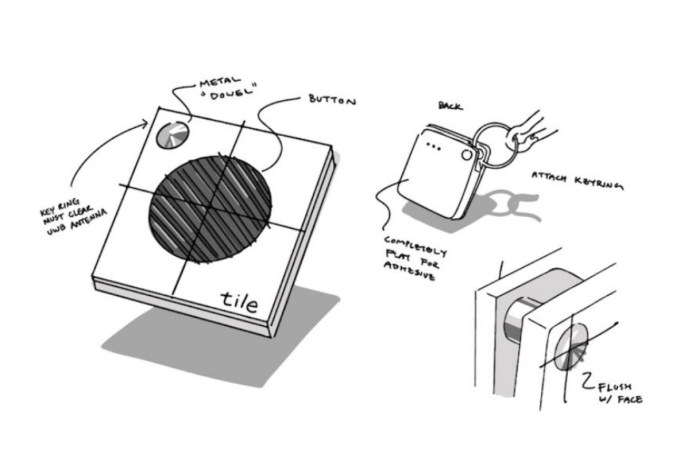
Image Credits: Tile internal concept art
Tile has been vocal on the matter of Apple’s anti-competitive behavior, having testified in multiple Congressional hearings alongside other Apple critics, like Spotify and Match. As a result of increased regulatory pressure, Apple later opened up its Find My network to third-party devices, in an effort to placate Tile and the other rivals its AirTags would disadvantage.
But Tile doesn’t want to route its customers to Apple’s first-party app — it intends to use its own app in order to compete based on its proprietary features and services. Among other things, this includes Tile’s subscriptions. A base plan is $29.99 per year, offering features like free battery replacement, smart alerts, and location history. A $99.99 per year plan also adds insurance of sorts — it pays up to $1,000 per year for items it can’t find. (AirTag doesn’t do that.)
Despite its many differentiators, Tile faces steep competition from the ultra-wideband capable AirTags, which have the advantage of tapping into Apple’s own finding network of potentially hundreds of millions of iPhone owners.
However, Tile CEO CJ Prober — who joined the company in 2018 — claims AirTag hasn’t impacted the company’s revenue or device sales.
“But that doesn’t take away from the fact that they’re making things harder for us,” he says of Apple. “We’re a growing business. We’re winning the hearts and minds of consumers… and they’re competing unfairly.”
“When you own the platform, you shouldn’t be able to identify a category that you want to enter, disadvantage the incumbents in that category, and then advantage yourself — like they did in our case,” he adds.
Tile is preparing to announce an upcoming product refresh that may allow it to better take on the AirTag. Presumably, this will include the pre-announced ultra-wideband version of Tile, but the company says full details will be shared next week. Tile may also expand its lineup in other ways that will allow it to better compete based on look and feel, size and shape, and functionality.
Tile’s last round of funding was $45 million in growth equity in 2019. Now it’s shifted to debt. In addition to new debt financing, Tile is also refinancing some of its existing debt with this fundraise, it says.
“My philosophy is it’s always good to have a mix of debt and equity. So some amount of debt on the balance sheet is good. And it doesn’t incur dilution to our shareholders,” Prober says. “We felt this was the right mix of capital choice for us.”
The company chose to work with Capital IP, a group it’s had a relationship with over the last three years, and who Tile had considered bringing on as an investor. The group has remained interested in Tile and excited about its trajectory, Prober notes.
“We are excited to partner with the Tile team as they continue to define and lead the finding category through hardware and software-based innovations,” said Capital IP’s Managing Partner Riyad Shahjahan, in a statement. “The impressive revenue growth and fast-climbing subscriber trends underline the value proposition that Tile delivers in a platform-agnostic manner, and were a critical driver in our decision to invest. The Tile team has an ambitious roadmap ahead and we look forward to supporting their entry into new markets and applications to further cement their market leadership,” he added.


from Mobile – TechCrunch https://ift.tt/3C9GJTk
via IFTTT
Wednesday, 15 September 2021
SmartNews, a Tokyo-headquartered news aggregation website and app that’s grown in popularity despite hefty competition from built-in aggregators like Apple News, today announced it has closed on $230 million in Series F funding. The round brings SmartNews’ total raise to date to over $400 million and values the business at $2 billion — or as the company touts in its press release, a “double unicorn.” (Ha!)
The funding included new U.S. investors Princeville Capital and Woodline Partners, as well as JIC Venture Growth Investments, Green Co-Invest Investment, and Yamauchi-No.10 Family Office in Japan. Existing investors participating in this round included ACA Investments and SMBC Venture Capital.
Founded in 2012 in Japan, the company launched to the U.S. in 2014 and expanded its local news footprint early last year. While the app’s content team includes former journalists, machine learning is used to pick which articles are shown to readers to personalize their experience. However, one of the app’s key differentiators is how it works to pop users’ “filter bubbles” through its “News From All Sides” feature, which allows its users to access news from across a range of political perspectives.
It has also developed new products, like its Covid-19 vaccine dashboard and U.S. election dashboard, that provide critical information at a glance. With the additional funds, the company says it plans to develop more features for its U.S. audience — one of its largest, in addition to Japan — that will focus on consumer health and safety. These will roll out in the next few months and will include features for tracking wildfires and crime and safety reports. It also recently launched a hurricane tracker.
The aggregator’s business model is largely focused on advertising, as the company has said before that 85-80% of Americans aren’t paying to subscribe to news. But SmartNews’ belief is that these news consumers still have a right to access quality information.
In total, SmartNews has relationships with over 3,000 global publishing partners whose content is available through its service on the web and mobile devices.
To generate revenue, the company sells inline ads and video ads, where revenue is shared with publishers. Over 75% of its publishing partners also take advantage of its “SmartView” feature. This is the app’s quick-reading mode, and alternative to something like Google AMP. Here, users can quickly load an article to read, even if they’re offline. The company promises publishers that these mobile-friendly stories, which are marked with a lightning bolt icon in the app, deliver higher engagement — and its algorithm rewards that type of content, bringing them more readers. Among SmartView partners are well-known brands like USA Today, ABC, HuffPost, and others. Currently, over 70% of all SmartNews’ pageviews are coming from SmartView first.
SmartNews’ app has proven to be very sticky, in terms of attracting and keeping users’ attention. The company tells us, citing App Annie July 2021 data, that it sees an average time spent per user per month on U.S. mobile devices that’s higher than Google News or Apple News combined.
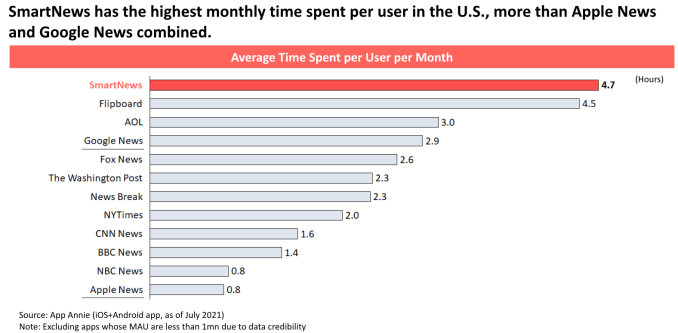
Image Credits: App Annie data provided by SmartNews
The company declined to share its monthly active users (MAUs), but had said in 2019 it had grown to 20 million in the U.S. and Japan. Today, it says its U.S. MAUs doubled over the last year.
According to data provided to us by Apptopia, the SmartNews app has seen around 85 million downloads since its October 2014 launch, and 14 million of those took place in the past 365 days. Japan is the largest market for installs, accounting for 59% of lifetime downloads, the firm noted.
“This latest round of funding further affirms the strength of our mission, and fuels our drive to expand our presence and launch features that specifically appeal to users and publishers in the United States,” said SmartNews co-founder and CEO Ken Suzuki. “Our investors both in the U.S. and globally acknowledge the tremendous growth potential and value of SmartNews’s efforts to democratize access to information and create an ecosystem that benefits consumers, publishers, and advertisers,” he added.
The company says the new funds will be used to invest in further U.S. growth and expanding the company’s team. Since its last fundraise in 2019, where it became a unicorn, the company more than doubled its headcount to approximately 500 people globally. it now plans to double its headcount of 100 in the U.S., with additions across engineering, product, and leadership roles.
The Wall Street Journal reports SmartNews is exploring an IPO, but the company declined to comment on this.
The SmartNews app is available on iOS and Android across more than 150 countries worldwide.


from Mobile – TechCrunch https://ift.tt/3tGufzs
via IFTTT
Tuesday, 14 September 2021
The TechCrunch crew is hard at work writing up the latest from Apple’s iPhone, iPad and Apple Watch event. They have good notes on the megacorp’s hardware updates. But what are the markets saying about the same array of products?
For those of us more concerned with effective S&P dividend yields than screen nit levels, events like Apple’s confab are more interesting for what they might mean for the value of the hosting company than how many GPUs a particular smartphone model has. And, for once, Apple’s stock may have done something a little interesting during the event!
Observe the following chart:
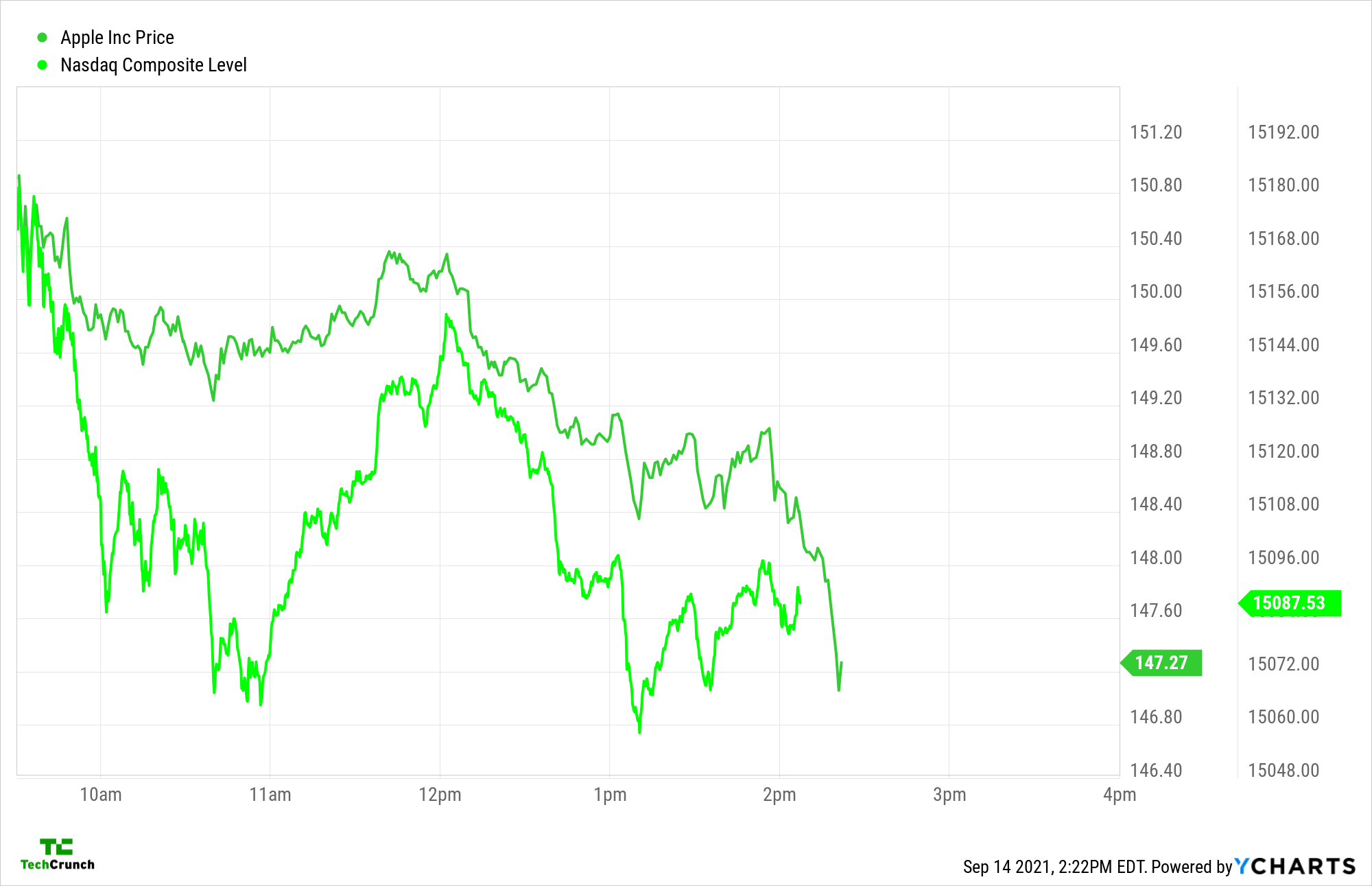
Image Credits: TechCrunch/Y Charts
This is a one-day chart, mind, so we’re looking at intraday changes. We’re zoomed in. And Apple kinda took a bit of a dive during its event that kicked off at 1 p.m. in the above chart.
Normally nothing of import happens to Apple’s shares during its presentations. Which feels weird, frankly, as Apple events detail the product mix that will generate hundreds of billions in revenue. You’d think that they would have more impact than their usual zero.
But today, we had real share price movement when the event wrapped around 2 p.m. ET. Perhaps investors were hoping for more pricey devices? Or were hoping Apple had more up its sleeve? How you rate that holiday Apple product lineup is a matter of personal preference, but investors appear to have weighed in slightly to the negative.
Worth around $2.5 trillion, each 1% that Apple’s stock moves is worth $10 billion. Apple’s loss of 1.5% today — more or less; trading continues as I write this — is worth more than Mailchimp. It’s a lot of money.
You can read the rest of our coverage from the Apple event here. Enjoy!



from Mobile – TechCrunch https://ift.tt/3zbOV3F
via IFTTT
Shortly after today’s virtual conference, Apple announced that the next major version of iOS will be ready for prime time very soon. iPhone users will be able to update to iOS 15 on September 20. The company first unveiled iOS 15 earlier this year at its Worldwide Developer Conference.
The biggest change of iOS 15 is a new Focus mode. In addition to “Do not disturb,” you can configure various modes — you can choose apps and people you want notifications from and change your focus depending on what you’re doing. For instance, you can create a Work mode, a Sleep mode, a Workout mode, etc.
There are many new features across the board, such as a new Weather app, updated maps in Apple Maps, an improved version of FaceTime and more. Safari also has a brand-new look. At first it was a bit controversial. Since then, Apple has listened to feedback and improved its new take on Safari.
The new version of iOS also scans your photos for text. Called Live Text, this feature lets you highlight, copy and paste text in photos. It could be a nice accessibility feature as well. iOS is going to leverage that info for Spotlight. You can search for text in your photos directly in Spotlight and it’ll pull out relevant photos. These features are handled on-device directly.
You’ll be able to update to iOS 15 if you have an iPhone 6s and later, any model of iPhone SE or the most recent iPod touch model. It’ll be available as a free download.
If you like your iPhone the way it is, Apple has also said that you don’t have to update to iOS 15. For the foreseeable future, the company will still update iOS 14 with security patches.


from Mobile – TechCrunch https://ift.tt/3lnkzpU
via IFTTT
The rumors were right. The centerpiece of today’s big Apple event is the latest iPhone. The latest device lands less than a year after its predecessor, now that things have settled down somewhat on the supply chain side for Apple. Last year’s iPhone 12 was a massive seller, bucking the trend of stagnating smartphones sales, in part due to a bottleneck in sales from the unplanned delay, but also because it finally brought 5G connectivity to Apple’s mobile line.
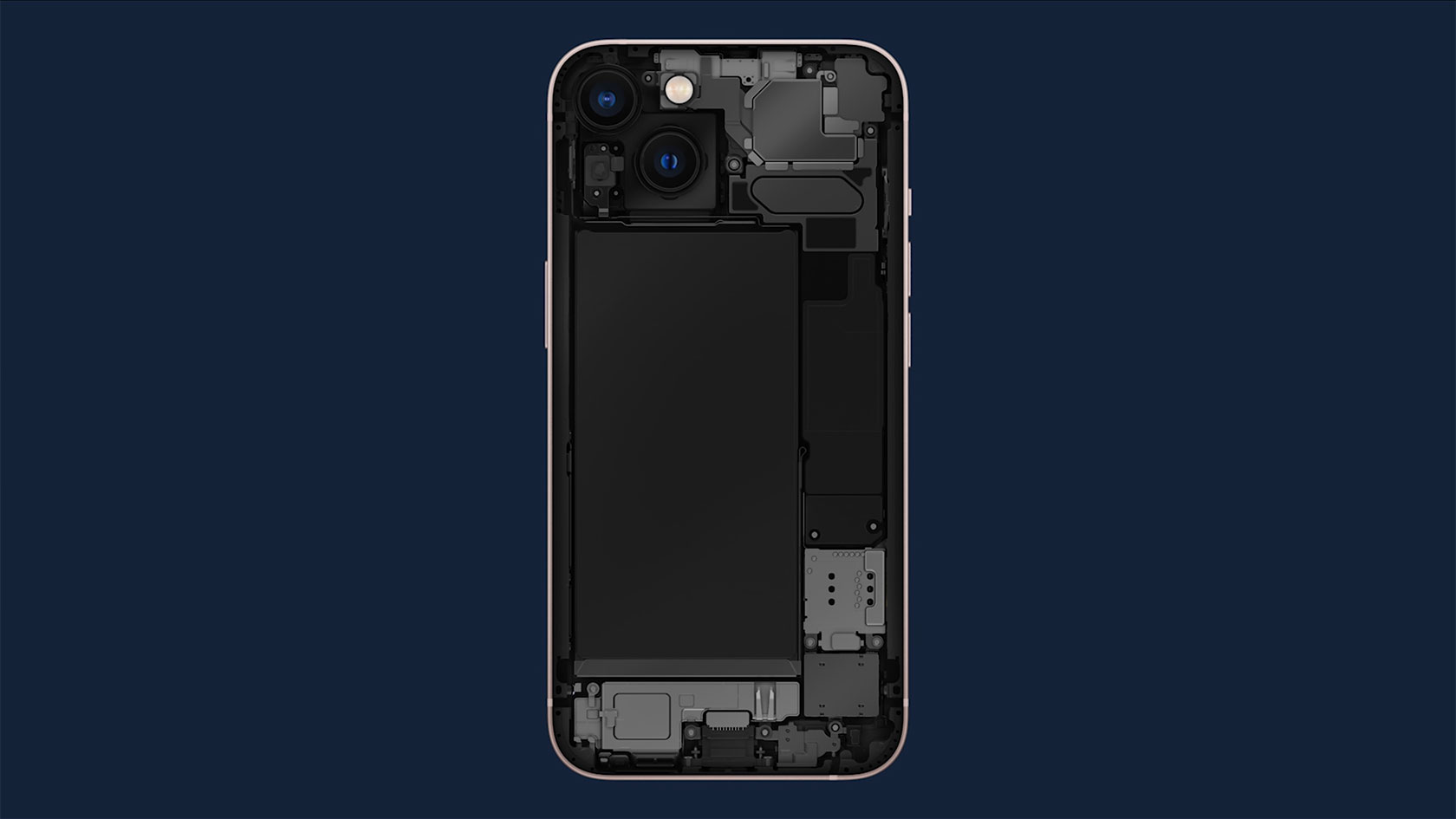
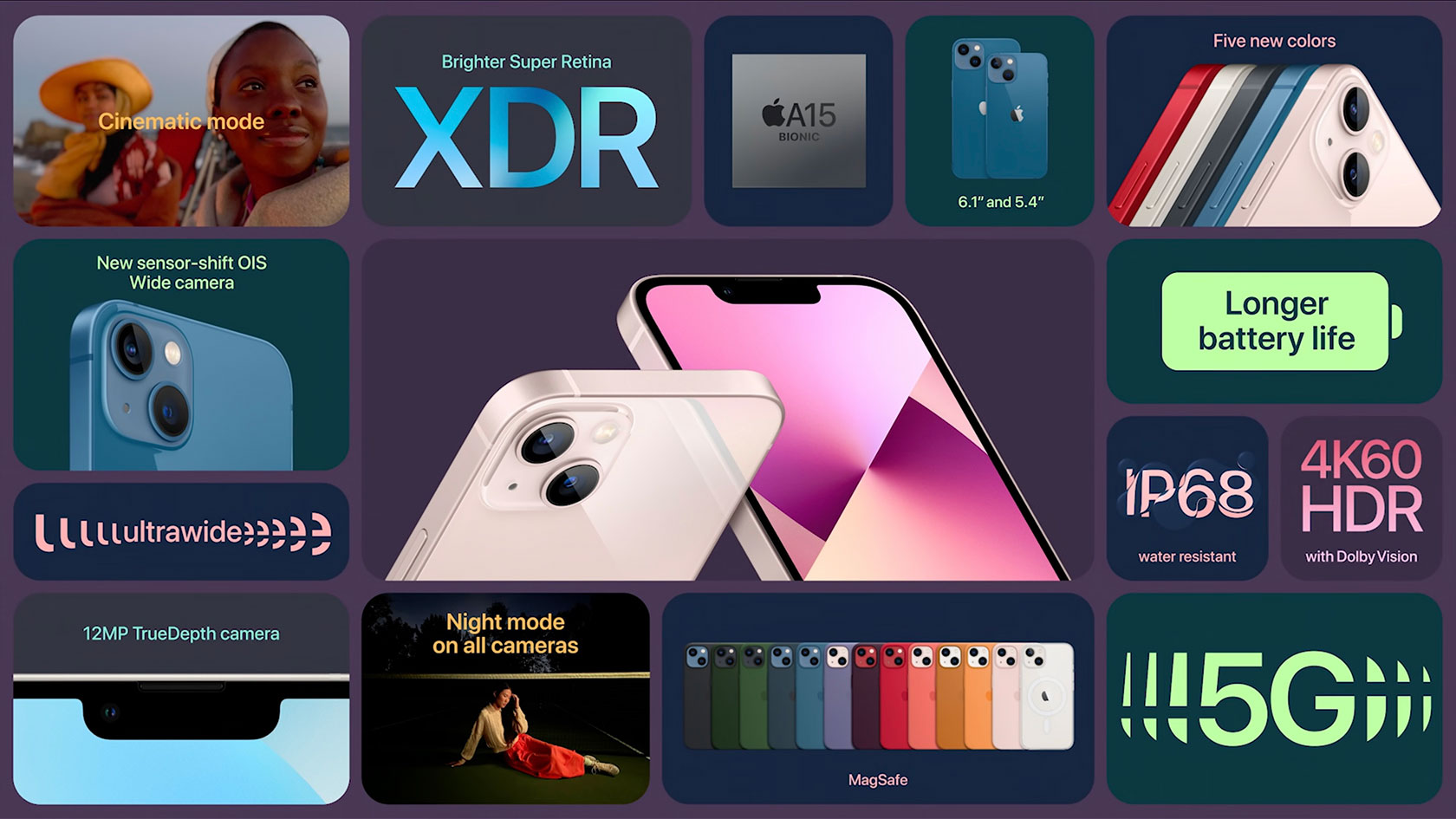
Lucky number iPhone 13 (no skipping for superstition’s sake, mind) features a familiar design. The front notch has finally been shrunken down — now 20% smaller than its predecessor, while the rear-facing camera system has also gotten a redesign. The screen is now 28% brighter Super Retina XDR display on both the iPhone 13 and 13 mini at 1200 nits.
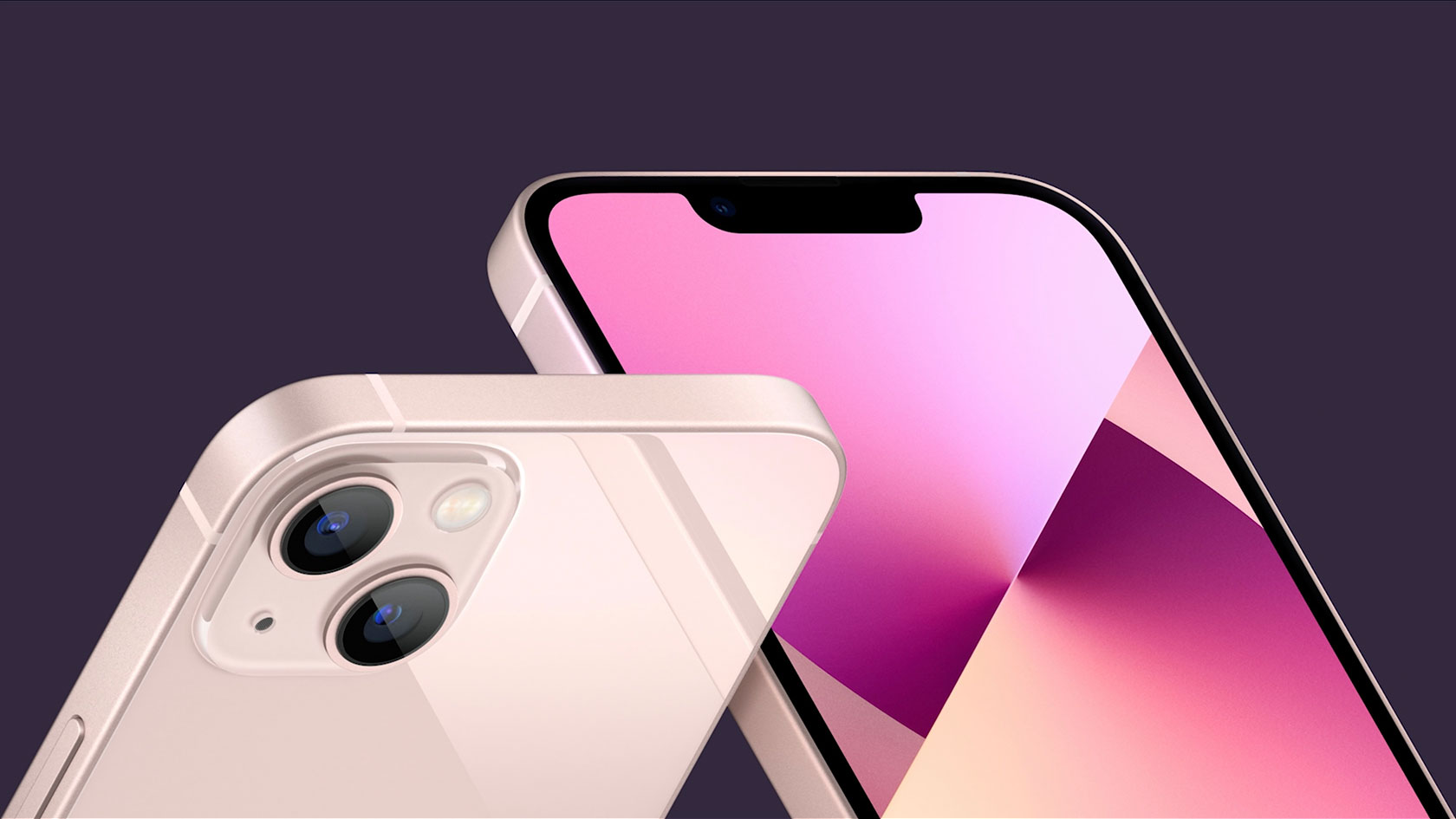
The 13 sports a 6.1-inch screen, while the mini’s is 5.4 inches — same as last year. The display is protected by a ceramic shield coating, and the handset rates IP68 dust/waterproofing.
The phone is powered by Apple’s new A15 Bionic chip, built with a 5nm processor. The CPU is 6-core that the company is calling “the fastest CPU on any smartphone.” The new 4-core GPU, meanwhile, brings advanced graphics to the handset.
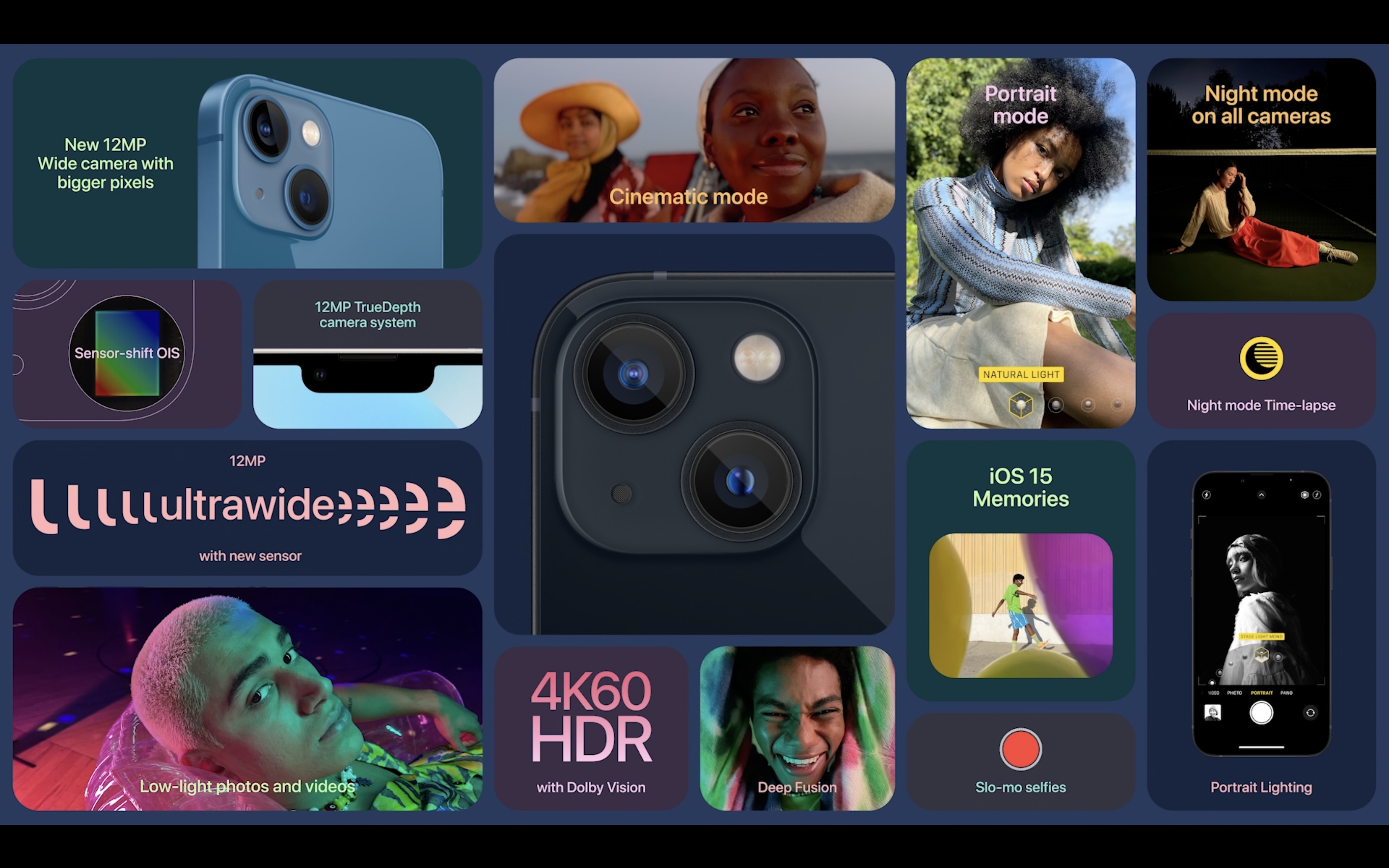
The rear dual-camera system features a 12MP wide angle camera that’s capable of pulling in up to 47% more light. The new Cinematic Mode, meanwhile, brings rack focus-style shooting capable of adjusting the focus on subjects, using machine learning (you can also tap to adjust manual or switch between subjects). All models in the iPhone 13 also support Night Mode shooting, as well as the ProRes codec for a more pro-level of video.
Following last year’s introduction of 5G, the company has added more advanced antennae. Through the combination of a larger battery and energy saving software, the company says it’s been able to eke out an additional 2.5 hours of life on the 13 and 1.5 hours on the mini.
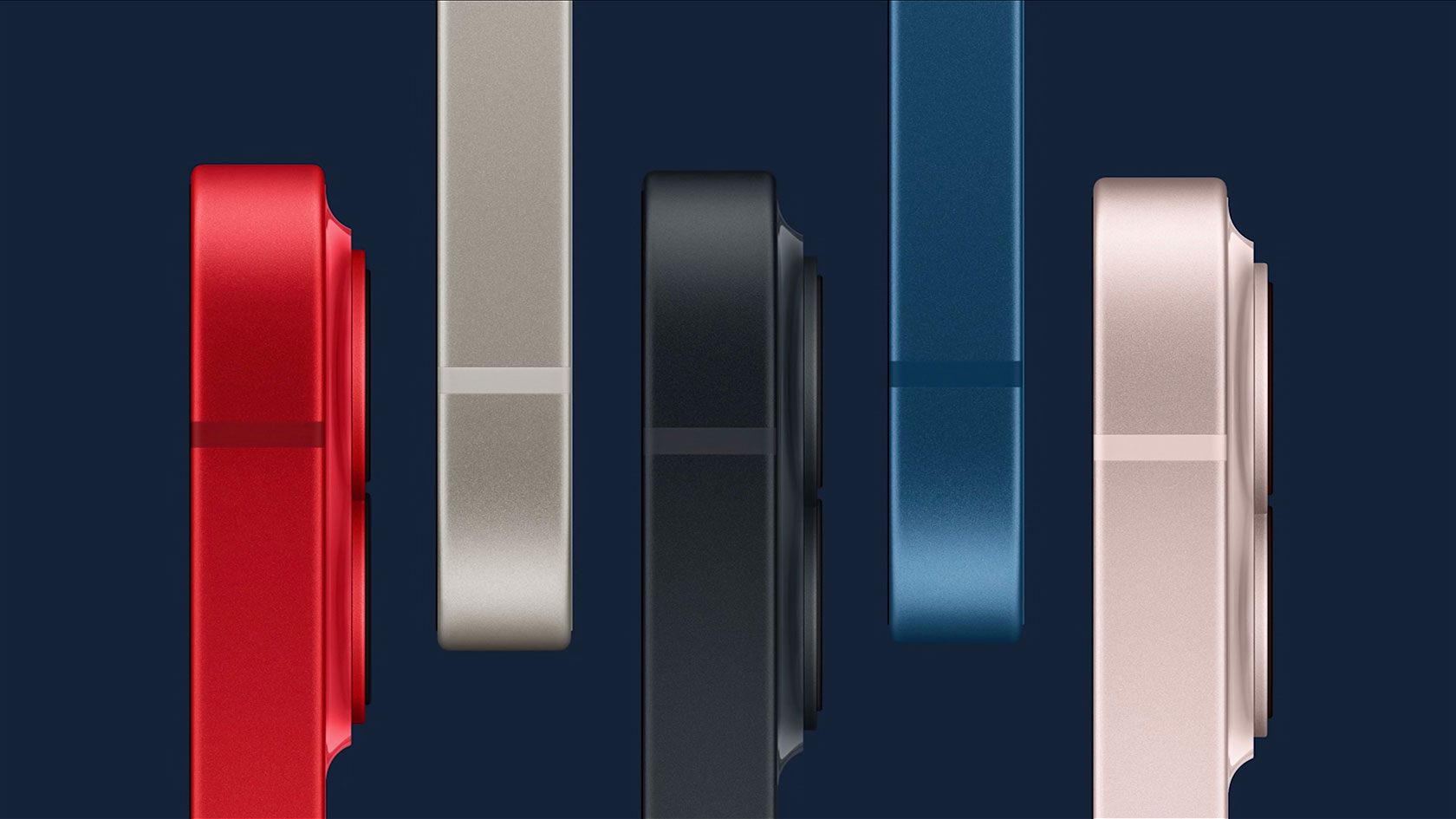
iPhone 13 mini starts at $699 and, while the 13 starts at $799. It comes in black, gold, silver and a new, lighter blue. Storage options start at128GB.
Not a massive update all told — Apple seemingly save a lot of that for the iPhone 13 Pro, which brings a 120Hz display (a feature that was rumored across the line) and a number of key updates to the imaging system. The Pro and Pro Max feature similar battery upgrades as the 13. The devices go up for pre-order on September 17 and will be available at retail on September 24.
The company is also launching a number of accessories, including a new MagSafe Wallet that works with the Find My feature.


from Mobile – TechCrunch https://ift.tt/3kawh7L
via IFTTT
TikTok announced this morning that it is implementing new tactics to educate its users about the negative mental health impacts of social media. As part of these changes, TikTok is rolling out a “well-being guide” in its Safety Center, a brief primer on eating disorders, expanded search interventions, and opt-in viewing screens on potentially triggering searches.
Developed in collaboration with International Association for Suicide Prevention, Crisis Text Line, Live For Tomorrow, Samaritans of Singapore, and Samaritans (UK), the new well-being guide offers more targeted advice toward people using TikTok, encouraging users to consider how it might impact them to share their mental health stories on a platform where any post has the potential to go viral. TikTok wants users to think about why they’re sharing their experience, if they’re ready for a wider audience to hear their story if sharing could be harmful to them, and if they’re prepared to hear others’ stories in response.
The platform also added a brief, albeit generic memo about the impact of eating disorders under the “topics” section of the Safety Center, which was developed with the National Eating Disorders Association (NEDA). NEDA has a long track record of collaborating with social media platforms, most recently working with Pinterest to prohibit ads promoting weight loss.
Already, TikTok directs users to local resources when they search for words or phrases like #suicide,* but now, the platform will also share content from creators with the intent of helping someone in need. The platform told TechCrunch that it chose this content following consultation with independent experts. Additionally, if someone enters a search phrase that might be alarming (TikTok offered “scary makeup” as an example), the content will be blurred out, asking users to opt-in to see the search results.
As TikTok unveils these changes, its competitor Instagram is facing scrutiny after The Wall Street Journal leaked documents that reveal its parent company Facebook’s own research on the harm Instagram poses for teen girls. Similar to the Gen Z-dominated TikTok, more than 40% of Instagram users are 22 or younger, and 22 million teens log into Instagram in the U.S. each day. In one anecdote, a 19-year-old interviewed by The Wall Street Journal said that after searching Instagram for workout ideas, her explore page has been flooded with photos about how to lose weight (Instagram has previously fessed up to errors with its search function, which recommended that users search topics like “fasting” and “appetite suppressants”). Angela Guarda, director for the eating-disorders program at Johns Hopkins Hospital, told The Wall Street Journal that her patients often say they learned about dangerous weight loss tactics via social media.
“The question on many people’s minds is if social media is good or bad for people. The research on this is mixed; it can be both,” Instagram wrote in a blog post today.
As TikTok nods to with its advice on sharing mental health stories, social media can often be a positive resource, allowing people who are dealing with certain challenges to learn from others who have gone through similar experiences. So, despite these platforms’ outsized influence, it’s also on real people to think twice about what they post and how it might influence others. Even when Facebook experimented with hiding the number of “likes” on Instagram, employees said that it didn’t improve overall user well-being. These revelations about the negative impact of social media on mental health and body image aren’t ground-breaking, but they generate a renewed pressure for these powerful platforms to think about how to support their users (or, at the very least, add some new memos to their security center).
*If you or someone you know is struggling with depression or has had thoughts of harming themselves or taking their own life, The National Suicide Prevention Lifeline (1-800-273-8255) provides 24/7, free, confidential support for people in distress, as well as best practices for professionals and resources to aid in prevention and crisis situations.


from Mobile – TechCrunch https://ift.tt/3EglQaK
via IFTTT
The Korea Fair Trade Commission (KFTC) said on Tuesday it fined Google $177 million for abusing its market dominance in the Android operating system (OS) market.
The U.S. tech company has restricted market competition by prohibiting local smartphone makers like Samsung Electronics and LG Electronics from customizing their Android OS, through Google’s anti-fragmentation agreements (AFA), according to the antitrust regulator statement.
Under the AFA, smartphone developers are not allowed to install or develop “Android forks”, modified versions of Android.
The KFTC banned Google LLC, Google Asia Pacific and Google Korea from imposing local smartphone developers to sign the AFA and make changes on details about the existing version. The new measure in South Korea will be applied to not only mobiles devices but also other Android-powered smart devices including watches and TVs.
Android’s compatibility program has spurred innovation among Korean mobile operator owners and software developers and that has led to a better user experience for Korean consumers, Google said in its statement. “The KFTC’s decision released today ignores these benefits, and will undermine the advantages enjoyed by consumers. Google intends to appeal the KFTC’s decision,” a spokesperson at Google said.
The commission has been investigating Google over the anti-competition practice in OS market since July 2016, a spokesperson at KFTC said.
Google’s global mobile OS market share excluding China has been increased to 97.7% in 2019 from 38% in 2010, as per KFTC’s announcement.
Google’s AFA has also limited to launch tech companies’ new devices like smart watches and TVs using the operating system (OS) including Samsung’s smart watch in 2013, LG Electronics’ LTE smart speaker in 2018 as well as Amazon’s smart TV in 2018.
South Korea’s watchdog is probing into three other cases including the Play Store app market, billing system and the advertisement market.
Meanwhile, South Korea’s “anti-Google law”, takes effect on 14 September, based on Korea Communications Commission’s press release.
In late August, South Korea passed a bill to curb global tech companies including Google and Apple from imposing their own proprietary in-app payment service and commissions on app developers.


from Mobile – TechCrunch https://ift.tt/3hvMrqK
via IFTTT
